Transforming Converter Aisle Operations with Digital Twin Simulation
Enhancing safety, operator readiness, and production performance through advanced remote crane simulation.
HOW SIMULATION HELPED IMPLATS MAKE A SAFER DECISION – WITHOUT RISKING A SINGLE RAND
Enhancing safety, operator readiness, and production performance through advanced remote crane simulation.
THE CHALLENGE
OPERATORS IN THE CROSSFIRE OF A HIGH-RISK SMELTING PROCESS
Impala Platinum (Implats) is one of the world's leading producers of platinum group metals (PGMs), operating major smelting and refining facilities across South Africa. In their converter aisle operations, overhead cranes transport ladles of molten material between converters — a highly choreographed, time-critical process.
During smelting, sulphur dioxide (SO₂) is released and rises to the upper levels of the facility where crane operators are stationed. Prolonged SO₂ exposure is a regulated occupational health hazard under the Mine Health and Safety Act (MHSA), creating both a human welfare obligation and a compliance risk for the business.
Implats needed to answer a difficult question: could operators be relocated to safer vantage points — or moved to a fully remote operating model — without compromising the throughput performance that underpins the operation's viability?
STUDY OBJECTIVES
Determine the operational feasibility of relocating crane operators away from the SO₂ exposure zone.
Quantify the impact of operator relocation on cycle time and daily throughput.
Identify system bottlenecks and operational constraints introduced by the new model.
Evaluate and compare multiple operating scenarios to determine the most viable strategy.
Provide confidence in the predicted outcomes before any capital commitment is made.
THE APPROACH
A DIGITAL TWIN OF THE CONVERTER AISLE – BUILD BEFORE ANY CHANGES WAS MADE
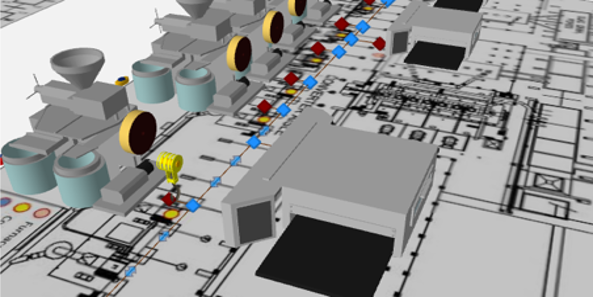
4Sight OT | Simulation deployed a discrete-event simulation model to digitally replicate the converter aisle in its current state. This baseline model captured the full operational cycle: ladle loading, crane transport, converter tipping, waste removal for granulation, and final product emptying — along with the precise movement paths and travel times of operators on the floor.
What Was Modelled
Baseline scenario: as-is operating conditions with operators co-located with the cranes Alternative scenario: operators relocated to designated vantage points, repositioning cranes remotely from fixed positions.
Fatigue modelling: reduced operator walking speed over the course of a shift was factored into the alternative scenario, reflecting real-world human performance degradation.
Stress testing: the model was pushed beyond current demand levels to identify the throughput ceiling under each operating strategy.
Multiple replications were run for each scenario to ensure statistical reliability, giving Implats a high-confidence view of probable outcomes — not a single-point estimate.
KEY FINDINGS
THE SIMULATION DELIVERED A CLEAR ANSWER
After modelling and analysing all scenarios across multiple replications, the simulation produced three critical findings that directly shaped Implats’ decision-making:
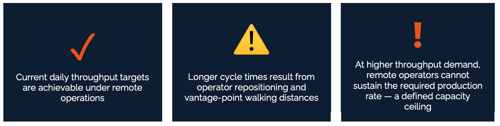 The fatigue factor — reduced operator walking speed over a shift — was confirmed as a meaningful variable. Its inclusion in the model gave Implats a more realistic picture of performance across a full production shift, not just theoretical peak conditions.
BUSINESS IMPACT
CONFIDENT DECISIONS. ZERO CAPITAL AT RISK
The value of simulation in this engagement went beyond answering the feasibility question. It fundamentally changed how Implats could approach the decision:
Risk-Free Scenario Testing: Multiple operating configurations were evaluated in a virtual environment before a single physical change was made. Implats could test, compare, and stress-test strategies without disrupting live operations.
Capital Avoidance Through Insight. Rather than committing upfront to infrastructure upgrades — new walkways, ground improvements, additional safety systems — the simulation revealed whether those investments were even necessary. Decisions were made with data, not assumptions.
Statistical Confidence at Scale: Running multiple replications per scenario produced statistically robust predictions. Implats received a confidence range around each outcome — not a single number that could mask variability.
A Forward-Looking Capacity View: Stress testing revealed the throughput threshold beyond which remote operations become unsustainable. This gives Implats a known planning boundary - a critical input for future capacity expansion decisions.
ABOUT 4SIGHT OT | SIMULATION
DE-RISK YOUR NEXT OPERATIONAL CHALLENGE
4Sight OT | Simulation brings over 50 years of collective experience in discrete-event simulation across mining, smelting, manufacturing, logistics, and processing industries. We build accurate, data-driven simulation models that enable your team to test 'what-if' scenarios, identify bottlenecks, and make high-confidence decisions — before committing to capital investments or operational changes.